
Interview – Testament’s Chuck Billy Reflects on Life + Career in New Book
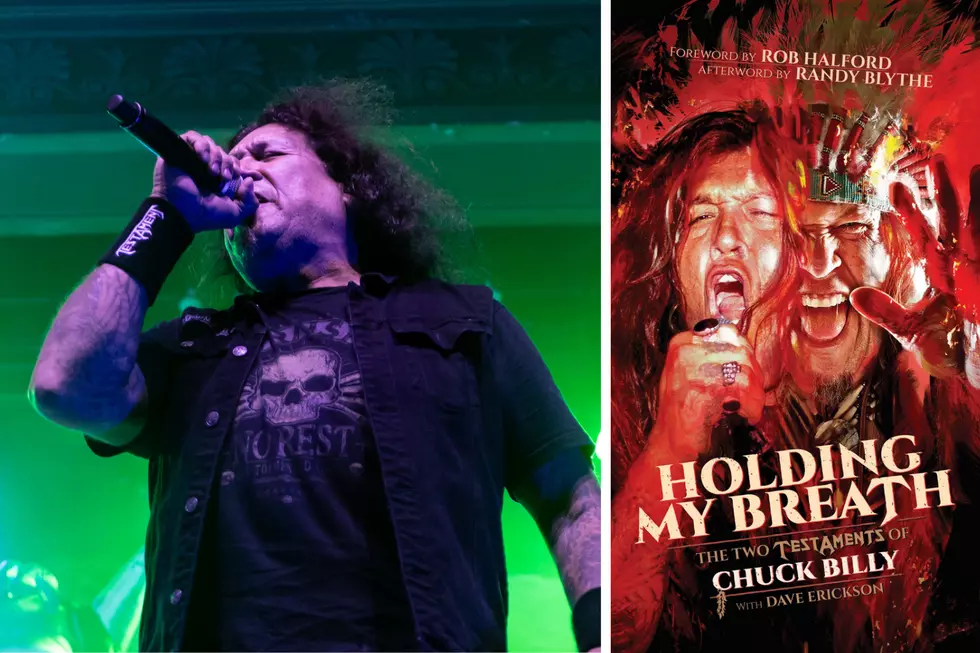
Like many growing up in the '70s, Testament's Chuck Billy was drawn to the spectacle and sounds of KISS. In fact, he told Full Metal Jackie he left his first KISS show with a rather unique, and somewhat gross, collectible.
"My first show, I got Gene Simmons to spit blood on me, so I had a shirt with blood from Gene Simmons. So that was the thing that I held as the collectible. And it was disgusting looking after years of just being dried up. But I saved it," shared Billy.
The Testament frontman found Simmons inspiring, adding, "To me, I related to him because he was a big guy. And I was, 'Whoa, there's another big guy that's just dominating the stage and his presence.' So that really kinda said, 'Okay, I could be that kinda guy, too.' So I related to it. And then I just loved the KISS collection of all the songs." He even shares in his new memoir, Holding My Breath: The Two Testaments of Chuck Billy, going home from the show and pretending to be KISS for his fellow neighborhood kids by mimicking their records while playing tennis rackets.
Everyone has to start somewhere and Chuck goes in depth on his childhood, the band's history and more within the new memoir. In this chat with Full Metal Jackie, he speaks about how his mother viewed his pursuit of music, what it was like auditioning to get signed the same day they learned of Cliff Burton's death and later finding a greater spirituality following his cancer battle.
In addition, Chuck offers an update on their Souls of Black reissue as well as insight on the progress of the next Testament album. Check out more of the chat below.
It's Full Metal Jackie, and I'm very excited to welcome back to the show one of our favorites, Testament vocalist Chuck Billy. This is a big year for Chuck, who is sharing his story in the new memoir, Holding My Breath: The Two Testaments of Chuck Billy. This book is equally divided into your early years growing up and Testament's rise to your cancer battle in your 30s and of course the aftermath. There's much of your story that's been told through the years, but how was it reflecting on your youth, your family life and analyzing it as an adult to see how your parents shaped you? Age sometimes brings wisdom. Anything from thinking back to your youth that now comes so clear and you didn't realize it as a young man?
After telling the story and putting it all together and starting from the beginning and connecting some of the dots along the way, especially the title, Holding My Breath, how we came up with that, it just made sense. And it was very therapeutic to do this.
But it really did open my eyes to who that young kid is, eight-month-old old kid holding his breath, to where I am at today, still holding my breath sometimes, trying to get my way or use my size as an advantage sometimes. So it was just, it was a very odd thing to do, especially 'cause I'm really personable.
I don't like to talk a lot and so to sit there and talk about yourself, it's kind of uncomfortable a little bit.
Testament, "Shadow People"
Chuck, the book details the hardships your mother and father faced in their early years, but it appears your mother had a musical background. Was she big in influencing your love of music and how did she feel about your chosen career path in music?
I think she was an influence because she sang when we were kids. She loved singing, but she had an unfortunate experience as a singer, though, as a child. So I think for me, it was always kind of a negative thing from what happened to her wanting to become a singer and me wanting to be a singer. So that was kind of the rough thing for her, was always, "Don't be a singer. go to college. Get a job. Don't do that."
That definitely influenced me as wanting to be a singer when ... I always wanted to be a guitar player, so when singing came up, I thought, "You know, wow, my mom sang, so yeah, maybe there's something there." And, in the end, she was proud. She came and saw me perform once in my life and she was very proud of the moment, you know? And that was it.
Did she feel like she realized, like, "Oh, wow, he really did this?"
She did. Once we had some records coming out and the one show she saw was where it's a local home show. We're opening up for Judas Priest. It's massive show. And I think at that point, she realized okay. She gave the blessing that okay I approve.
That must have felt good. Not everybody gets that in their life from a parent.
Especially as much as she was, my whole life, the opposite way. She really just cared about her kids going to school. That was it, school, school, education, good job. She wanted this for her kids, so you know. It turned out alright.
I think you turned out alright, Chuck Billy.
Yeah. Yeah.

Chuck, what first drew you to heavy music? Was it the first love or did something else grab your attention before you graduated to embracing heavier music?
I think it was the guitars that always drove me to like that dirty-sounding guitar. So I think that's still kinda grabbed me. Anything like that, back in those days when it was all about the vinyl album covers. So the crazier it looked, you were drawn to those.
And those were back in the days when you used to walk in the record store and they'd have the vinyl sitting on the counter and they'd be playing it so you could at least hear it and sample it and go, "Wow, look at that cover. That's so cool."
I remember seeing the Exciter cover [for Heavy Metal Maniac],. It was like a knife in a Marshall stack. I'm like, "Oh, man, I gotta have that record." It's just those things.
In this book, you discuss the impact of KISS during your formative years. I'd be remiss if we didn't get into the KISS fandom a bit. What, in your opinion, was KISS' best work, and as a fan, do you have a favorite piece of KISS memorabilia or something that you collected from the band?
My first show, being so young and that experience, I don't think I still have it. I gave it to one of my best friends, 'cause he saves everything. But my first show, I got Gene Simmons to spit blood on me, so I had a shirt with blood from Gene Simmons. So that was the thing that I held as the collectible. And it was disgusting looking after years of just being dried up. But I saved it. That was the one thing.
But for me, that was my first big live show to see Gene Simmons. And to me, I related to him because he was a big guy. And I was, "Whoa, there's another big guy that's just dominating the stage and his presence." So that really kinda said, "Okay, I could be that kinda guy, too." So I related to it. And then I just loved the KISS collection of all the songs.
The show was unlike anything I'd never seen before at that time with the fireworks and the fire and the blood and just all of it, you know? So that's what got me. And right away, I think shortly after that, 'cause I think it was only like 1976, so was 12 years old when I saw them. We're still going home at that point and I opened up the garage door with the tennis rackets pretending we're KISS, mimicking to their records, you know? That's what we did then. That's what started it.
We were just sort of touching on the KISS fandom. And I love in the book you discussing seeing KISS live, then of course what you mentioned, recreating it with tennis rackets for the neighborhood kids. I can just envision the moves. That said, can you talk about what it meant to see the dedication that KISS put into a live show like that from the moves to the production? And did it impact what you wanted to do later as a singer?
Well to see them was to see the KISS Alive! record and see how fun it looked in the crowd and to be there in the crowd and it was way beyond the photo, the sound and everything. And also just being that young of a kid, first experiencing marijuana. People are smoking marijuana around us, and they're like, "Wow," I might've even gotten contact high I think at that point being around it so much. But yeah, that was the start of it all for me, that KISS journey.
That started the war between my brothers. I'd start collecting the KISS posters and they'd had the Led Zeppelin posters and the, the war began. I was defending KISS all the way, and they'd defend Jimi Hendrix and Led Zeppelin the whole time.
Chuck, a key moment in Testament's career coincided with, with one of the saddest moments in metal history and you speak about it in the book. Can you talk about trying to mentally prepare for a showcase to get signed as both you and the people coming to see you were dealing with the death of Cliff Burton? I can't imagine trying to keep it together through that.
It was definitely tough, you know? Cliff was our local hero and to receive the news was, first of all, all of us just kind of jaws dropped. We didn't know what to say, the sadness.
Here we are, we worked very hard to get this opportunity to get signed. We actually... They had a deal. [Singer Steve] Zetro [Souza] left. I did a demo. They liked the demo, wanted to see the band. So we went through all of this for this moment and when they arrived, they were wiped out. They were just up all night. And we knew something was wrong. And when they told the news, we were blown away that, "Okay, we need to call this off. This is just not the right time to do this." But they wanted to move forward. They said, "No, we're here. We're here. Let's just do your thing." And we did, but it was the most somber performance. No smiles, attitude. We just were so serious.
We played our songs and kinda just quietly put down our instruments. And they were just like tired and it was just kinda like, "Okay. We like what we heard. We have a deal. We'll talk to you soon," and just kind of like, "We're gone" to go deal with what they needed to deal with.
But they did put in the time to really listen to what we were doing and we got signed. But it was just the worst day and best day ever, you know?
Right. No, it must've been very surreal. You're excited but yet somber and it must have been like a mindf--k to not know how to feel.
Not at all, but to not even be kind of happy after we just accomplished what we had set out to do, to get signed to Megaforce and and now we're gonna be signed, and the emotions just weren't there to celebrate.
I don't think we celebrated till days later when they were gone and we realized at the studio, like, "Yeah, we're doing it." It was a very, very strange thing for us. But again, it's something that is just another path that we had to go through to get where we're at.
Chuck, in interviews around this book, you've talked about becoming a more spiritual person rather than a religious person following your cancer battle. Can you go a little deeper into that explanation? What has embracing a more spiritual perspective meant getting through your battle and how you view things having survived that?
I think I've probably mentioned that my mother's always been a very religious lady and when we were younger, she put going to church every Sunday and catechism, after school studies and stuff [above all]. She was really into that for us. So I was raised religious.
So after touring the world, growing up, putting some years on the planet, meeting all these cultures and seeing that there's more than one god or higher power that we all can believe in, I was open to that.
READ MORE: Chuck Billy Gets Emotional Over Memoir Contributions From Metal Legends
But then when I did the Native American healing and went that route, and it was very unbelievable. I just still, to the day, I can't believe some of things that happened, that it wasn't about being religious that did it, it was just being spiritual and believing in something, believing in a higher power.
And I think coming out of that, I could say that, yeah, I'm spiritual. If you went in my house, I have Jesus posters to Baphomets to every culture god there is because, I'm open to everybody's belief that there's something to believe in out there.
I'm spiritual I would say now. What does spiritual mean? I mean, that's just being a good person, doing right and wrong. I mean, I guess that's the gist of it.
Chuck, there are other things going on in the Testament world. The reissue process has you now taking on Souls of Black. What are your recollections of that record, and now that you've been remixing it as of late, is there anything that stands out that you'd like to give more attention that had been kind of forgotten with time?
Well, now that we revisited and did the remix on it, we weren't really a part of the mix process back then and we're full on in the mix process today in all our records. So once we got the tracks and got to go through them and do what we do like we do to our records now, wow, what a difference it made.
It's night and day what we've seemed to accomplish on the record and it sounds really modern and punchy and fat now. And so we're excited to what we got to do that people are gonna hear on this record because we always just thought it was a good record and it sounded good, but it was recorded good. But I think it was over-processed in the mastering prod. It just got squished. So when I heard it on the radio, it just always sounded squished to me and now it doesn't. It can breathe, sounds really strong. And it's been awesome having all the vinyls and I think we actually get The Ritual back in March next year. So maybe we can start on that process as well.
Chuck, as we've previously discussed, Para Bellum seems to have rejuvenated the band, and I know last we talked there had been some work underway on what's next. Just checking for sort of a status update and if there's anything that's standing out to you from the process so far. Is there anything inspiring you topic-wise as you work toward a new album?
Actually, Chris, our drummer, is actually here now, and Eric and them have about nine tracks already that I have and they have about three or four more they already have that I haven't heard yet. But again, they are on a roll. They're writing some very strong tracks, and it's really refreshing to hear 'cause it sounds right up the root of Para Bellum.
It sounds real fresh, real current. They're having fun with it. It's fast. It's heavy — everything we'd want a Testament record. So we're excited. So our plan is to get in the studio. We're not going to Europe next summer. We're gonna take that off and go and start recording the record probably next June.
Amazing. Wow. It seems quick, but I guess it's been a minute...
Yeah. Well, well, it was October last year, so yeah, we'll get one in within two years hopefully.
Doesn't seem like a year. I can't even believe it. It's crazy. Chuck Billy with us once again. His new memoir, Holding My Breath: The Two Testaments of Chuck Billy. So excited for this book to finally be coming out and I really appreciate you getting into it with me and taking the time.
Thank you so much. But make sure everybody goes to either chuckbillybook.com or you can find it on Amazon. You can get your pre-orders there or you can go to Premier Collectibles. And they got some pretty cool collectible stuff there.
Once again, thanks to Testament's Chuck Billy for the interview. As he said, be sure to check out Chuckbillybook.com to get Holding My Breath: The Two Testaments of Chuck Billy. And stay up to date with Testament via their website, Facebook, X and Instagram platforms. Find out where you can hear Full Metal Jackie's weekend radio show here.
Below, revisit our picks for the 11 Best Thrash Albums of 2025.
The 13 Best Thrash Albums of 2025 (Ranked)
Gallery Credit: Loudwire Staff
More From Loudwire