
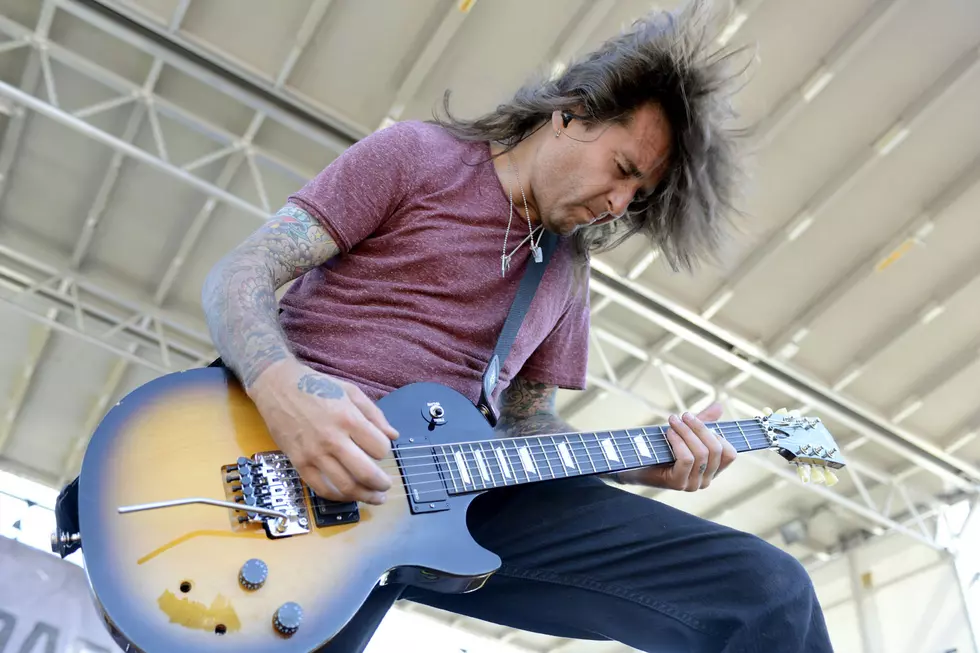
Darkest Hour’s Mike Schleibaum Shares Favorite Guitar Solos From ‘Suffer Divine’
Leave it to a guitarist to geek out over guitar solos. So we did, as Full Metal Jackie started digging in with Darkest Hour's Mike Schleibaum about the guitar work he and fellow guitarist Nico Santora brought to the band's latest album, Suffer Divine.
When asked about his favorite solos on the record, Schleibaum first shouted out Nico Santora for his work essentially starting "The Unforgiving Hand" with a near two-minute long solo. "It has almost like a Pink Floyd structure where it's like a really long guitar solo and then an emotive release at the end," he shares. "I'm like the dude who's always pushing for these crazy song structures and these stupid ideas, but it's really works and it really brings his style, his moody style."
As for his own work on the record, he's quick to recognize "Everyday Horrors," in part for the journey it took. "[It] wasn't even supposed to happen. There was other stuff that was going on in the song and then we kinda rearranged it," he recalls. "So for this song, we wanted something that really, really felt Exodus, really felt Slayer, really just felt like that style. And so I had to come up with it there and with everybody and it was just fun to be able to do that and have it come out so good. So that's my favorite."
Elsewhere in the interview, Schleibaum tells Jackie that the new Suffer Divine album may challenge the thinking of those who consider them a metalcore band. He also digs into the narrative ideas that permeate the record and why it was important to leave listeners with an open-ended question in the album closer. And the guitarist shares some of his favorite music of 2026 that continues to influence himself and the band in a variety of ways.
Check out more of the chat below.
It's Full Metal Jackie and I am so excited because I have Darkest Hour riffmeister Mike Schleibaum with us. The band is back and stronger than ever with their eleventh studio record, Suffer Divine. Mike, that's an interesting album title. Can you tell me how the idea of Suffer Divine ultimately plays into what Darkest Hour did in creating this record?
This is funny because over the course of today where I've been doing a bunch of interviews, I had to Google what is the definition of a concept record. And it turns out, I guess we wrote one.
I think when you're in the bubble and you're writing this stuff, you're wondering, are we just screaming into the void? Is this just decoration that's going over the music? But anyway, the overarching theme of this album, Suffer Divine, is a play on this Christian idea of divine suffering. One can find worth in and value in basically acknowledging, addressing and living through some sort of suffering or adversity.
This is loosely a play on it because we're definitely not coming at it from a Christian angle. We're more coming at it more as a band. We've had to accept that if something isn't wrong, then it doesn't feel right.
Mike, you were just talking about this idea that as a band, if something isn't going wrong, it almost doesn't feel right. After doing this for as long as you guys have, how much has learning to live with that constant struggle shaped what this new record, Suffer Divine, is about?
Everything is always going wrong somehow. Your idea of success, the goalpost is always moving. You are constantly playing this spin game in your head. We were talking for a minute about as artists we have to question, 11 records, dedicated to your life.
People can say this is me and John's life's work to do a melodic death metal band. But why would you do this? Why do you continue to do this? These are things that you have to ask yourself and you have to be able to answer. And so as a person who loves heavy metal for the rest of his life and for his entire life, the same way that you do, it's why you dedicate your time to do all this. You're a lifer too, you can understand this.
I've accepted that this is tough. Oh, great, I have a band. Now the internet. Oh, now social media. Oh, now COVID. You know what I'm saying? Like, every step along the way, why? What is the "Now I gotta do this?"
Also, somebody was saying this to me, "Oh, it's so much work," and I was like, "But it's not work though. It's love though. We love to do this Are you kidding me?" Like, counting the T-shirts before you go on tour sounds like a job, but dude, we put on some Van Halen and it's the best. It's a place where we aren't even counting the T-shirts, we're just hanging around where everybody's counting T-shirts. It's the place to be, you know?
You accept that things are gonna go wrong and as a group you guys are gonna experience it together and that shared experience actually becomes the journey and that is actually the reward for doing this entire bull. So once you sort of accept all that, you realize, you are the eye of the storm in a sense in that your personal spin, your personal war in here is your perspective of it is all that you can change and all that you can control and really all that matters.
And so as the songs dig into what they're about, they play into this idea. I will say that even though it is a very deeply, personal record, the songs are written to be universal.
So John [Henry], as the main lyricist, we work really tightly together on everything and he has to constantly be answering my questions. "What is this about? What are you trying, what are we trying to say here? What are people gonna think we're saying here?" He does a great job of translating our communications and our feelings and our conversations into these things that become very intimate expressions of himself and myself that I can speak on behalf on for all of us.
And so I think that speaks to the fact the songs are universal.
Mike, we were talking earlier about how personal this new record is, but at the same time, you wanted these songs to connect with people and feel universal. Was there something that really inspired the way you approached that when you were making Suffer Divine?
Something that really inspired me when we were making this record was I love old interviews, old rock footage and we were doing a deep dive of watching old Slayer interviews.
It was sick back in the day when Jeff Hanneman was the only dude that talked. He was unhinged, awesome, crazy. But he has this one interview they're doing in a graveyard where he's the only dude talking, like he's like the lead singer of the band, and he's like, "Slayer is gonna make no sense to anyone unless you're a person who has problems. This is music for people with problems, because we have problems. That's why we're here, and we love people with problems."
It's just kind of this whole spouting off all this about how it's just music for people by people. And I think that what's awesome and unique and special about our record too is that while we all have found some sort of balance to be able to continue to do this band, we're constantly in situations and having thoughts and all sorts of things that make us feel equally as crazy as what Hanneman's talking about.
We wanted to make a record that spoke to people who have been through and who have had to survive. And we understand we come at this from a place of privilege because there is a big spectrum of suffering in the world right now.
And to act like that I'm talking about is on the same comparable level that's happening is hard, but a lot of us are gonna fight our most important battle inside. So that's what this record is sort of like. Not really a handbook for, because we don't like rules and we don't like anyone telling us what to do, but more of a exploration on it, workshop on it.
Mike Schleibaum discussing Darkest Hour's new Suffer Divine album with us and I wanna get into the title track here. It's one of the first things we heard from this album and it's a very fitting statement given the divisiveness of things in the world these days. Can you speak to where the song comes from and do you personally see a way in which we can shut down the division or are things too far gone?
Okay. Well, first of all, let me say that I'm excited that you're gonna play this track because this is the first and only and special version of it that includes an edited, you know, bleep, 'cause it's an extreme song. So dude, we made this track especially for everybody here, 'cause they said, "Hey, we need an edited track." And it was like, whoa, I forgot that there was a cuss word.
We don't normally like to write ultra angry songs. Like, normally, a Darkest Hour song has a reflection on something to sort of play on that idea because we're not inherently just solely angry people. That said, like, when you're in the bubble of humanity that is now speaking through these stupid little devices, it is so easy to feel that rage and to feel how much accountability seems to be lost and how much the good guys seem to finish last.
So I think that this song is just really more of just a space where we realize that you can turn the comments off on the internet. But people are still talking wherever they want to. But the thing about a song is that we just get to do it and then it's there and then you need to think about it.
And that's why songs like "Nazi Punk's Bleep Off," which we cover, like, that's such a poignant, cool song because it's an idea that exists. Everybody has lots of opinions about using the word Nazi and stuff and stuff, but still, Jello [Biafra] put it out there. It's down there. It's an artistic statement.
Darkest Hour, "Suffer Divine"
Mike, we were talking about wanting to make a statement with this song and put some of that anger and frustration you're feeling out into the world. How much of that came from what you guys are actually seeing and experiencing around you?
We wanted to do something similar with this song and say something about it because we feel it. Like, we feel the division everywhere we go — in Uber drivers, at gas stations, at truck stops. We get little Polaroids of culture everywhere we go because we're basically just there for a second and then we're gone.
You start to see humanity fast, but you get to see it really close up and raw because you're seeing the basic interactions. And so we just kind of wanted to put it down and just be like, "Man, this is messed up. I don't know what it is, but I hope this person pays."
It's tough to put it out there 'cause like I said, we don't like to write angry songs, but that's part of it and that's part of this picture and that's part of suffering and that's part of pain and that's part of grief and it's part of working through all those things is accepting anger and then figuring out what to do with it.
And so that's sort of the flip of the song that I think makes it feel a full-circle Darkest Hour song because this idea that Tony Iommi getting his fingers cut off, he used that as a strength somehow. It tweaked the way he played guitar.
A lot of times, people's weaknesses, what's different about them, what's easily shameable about them can become their greatest attribute at times, their biggest lifeline into whatever they really wanna take their life. Your biggest weakness can become your biggest strength. And so sometimes you just need to wear that hate as warpaint.
What John is trying to say is you just gotta own it and become it because then it can't be taken away from you and it can't be used to harm you. You can use it as fuel. So something like that. Without also trying to tell you exactly what the song's about, so maybe you can read the lyrics and see what you think.
Mike, you said that sonically Suffer Divine is an album born of your collective love for things like melodic death metal. With that in mind, were there touch tones you were trying to hit in putting this record together, references of what either lyrically or sound-wise you wanted to incorporate in realizing this vision?
Man, it's funny. No one has asked me that yet, but we have sort of at our existence, we have played around in the sphere that is heavy metal, death metal, melodic death metal, hardcore and in that space. And most the time we've been sort of labeled as metalcore.
But having our ties to Sweden and sort of being one of the first American bands to really bleed that in there, sometimes if you get a real purist or a European, they might come in there and go, "No, Darkest Hour is melodic death metal. This other thing's metalcore." They're just lumped in there 'cause of their time frame. But we all love all these little subgenres of metal 'cause this is all kinda dumb.
That being said, when we started writing this record, we started to realize that, wow, this one is really distinctly melodic death metal. And that's okay. We're gonna wear that on its sleeve and just run it up the flagpole. But when you were asking the question, you're like, "Did you use anything of reference?" And it was funny 'cause my answer in my head immediately was like, "Yeah, us." Because I mean, while we do like to take influences from all over the place, a lot of the Swedish bands and even the newer bands that we went on tour with, Exodus. Well, not newer, but the bands we went on tour with recently. Exodus, Fit For an Autopsy, Undeath, Decapitated ... Taking in that kind of vibe, taking in those influences, as well as the old school ones, Carcass, At the Gates, Slayer, are all part of the family tree.
But really in the end it was as we were writing, it wasn't like, "Well, cool, like, make it sound a little Metallica. Make it sound a little this." It was like, "No," like, "Does it sound like Darkest Hour?" You know? And I think what this album is is a really focused, melodic death metal Darkest Hour album.
Early on in the process, you were beaming about how thrashy and aggressive everything was sounding and hyping up the guitar solos as "next level". That leads me to a pair of related questions. Between your stuff and Nico's, favorite solo off the album and why and does it surpass your overall favorite solo from your time in Darkest Hour?
Oh, God. We are getting in some ultra-geeky area here. So hopefully people don't just conk out, okay? But we love guitar solos, yada, yada, yada. Every record you gotta come up with something. People, 13-year-olds, nine-year-olds are blowing your mind out there with shredding stuff that they're doing. So how do you even stay relevant and keep to the true vision of the band and somehow play this game of guitar shredding heroics.
But Nico is ultra talented and he's a super awesome addition to the band. And just like me, he has a lot to say and that he wants to say with the guitar. And I'm really excited about the song "The Unforgiving Hand" on this record. It opens with like a two-minute long guitar solo, which is something we've never done before.
It has almost like a Pink Floyd structure where it's like a really long guitar solo and then an emotive release at the end. And I'm like the dude who's always pushing for these crazy song structures and these stupid ideas, but it's really works and it really brings his style, his moody style.
Darkest Hour, "The Unforgiving Hand"
We've had multiple lead guitar players. We have dual lead positions kinda like Maiden, but multiple other guitar players along the course of the band's trajectory and they've each brought something a little new to the game. And I used to say that Nico brought bends, 'cause he would just like bend the guitar. He would bend the notes. He would become emotive with it. But now I realize more than anything, he brought feeling and emotion to some of these things that was a little lacking with the speed and the complexity that we were doing in the past.
So I really think that the guitar playing on this record is really soulful and I think that that song especially really showcases Nico's talent as a soloist. But there are also other songs that have ripping solos.
Mike, we've been geeking out on the guitar playing on their new record, Suffer Divine. When it comes to your own playing on this record, what were you trying to bring to these solos and which one ended up being your personal favorite?
Every solo is tab-able, YouTube-able, proven. Five guitar players in a room voted yes, it's a sick kinda thing. My personal favorite solo that I contributed to on the record is actually on the song "Everyday Horrors," which wasn't even supposed to happen. There was other stuff that was going on in the song and then we kinda rearranged it.
There are times when we lean on this Slayeristic style and there's times when we lean on this classical style. We like to balance it all so it doesn't get boring and whereas like maybe Exodus does one style of solo and Slayer does one style.
Darkest Hour, "Everyday Horrors"
So for this song, we wanted something that really, really felt Exodus, really felt Slayer, really just felt like that style. And so I had to come up with it there and with everybody and it was just fun to be able to do that and have it come out so good. So that's my favorite.
But if you are a guitar player and solo fan and whatever, then you'll be happy to know that all this music will be available in Guitar Pro and PDF format for all you nerds to get on there and shred on the Instagrams and show us how much better you can play it than us.
But the thing is, it's a joy to compose heavy metal guitar in a way that makes people feel anything and makes them excited to learn guitar. Because the biggest compliment a guitar player can get is to have someone watch them play guitar and have that person say, "I wanna play guitar." Maybe they don't say, "I wanna play like that person," you know, "I wanna be like that person," but just have them say like, "Man, I wanna, I wanna play guitar."
Mike, this album ends with one of my favorites from the record, "A Story of Redemption." "The way it ends is up to you to decide," is such a killer line to leave listeners with. Why was it important to leave this open-ended, idea as the closing statement?
It might be some of the way that we communicate as a band, because we are a collaborative band even though we have very strong personalities. Any one of us is ready to walk all over everyone and be like, "Okay." But in the space in between those personalities interacting, it makes something very special, like a spark to a flame type thing.
Wo with this song, you really wanna just say it is up to you to decide. But to end it on a question sounds almost more argumentative, almost like you're having a conversation in that way. And it is kind of the way that we communicate because some of what we do does seem combative. I mean, sort of in the same way that people might see Sicilians talking, and they're really just saying, "Yo, how you doing?" It's great, but if you go to Sicily, man, it looks like they are going at it. But that's how they do it, you know? And so I think that the lyrics at times can be combative because I think that a lot of the things that we're talking about in the songs are tough. And so there has to be an element of where it almost needs to break through kind of like an argument.
This song especially is sort of like a zoomed out take on the whole record, where the main character is really personification of a lot of the ideas that are happening in the record and sort of like gets you to reflect on the whole thing and the journey of the whole thing.
It sort of all came together because it started more of this linear song and then took the shape of almost this, like, Iron Maiden-y type song. And it was like, "Oh, cool." Like, we haven't really done that in a long time or ever maybe. It felt special and felt like it could end the record and felt like it could be this sort of like closing of the circle thematically of this album because it's like we drop it all on you, we talk all about it, we talk about our reflections about it and then it's kind of like, well, now what are you gonna do with it?
Darkest Hour, "A Story of Redemption"
Mike, is there typically a moment where you can truly judge how you feel about the work you've done for an album? Is It when you finish the record, seeing how fans respond to it, finishing the album and tour cycle, or even years later seeing how the songs evolve within the live performance? And where do you currently sit with this new record?
I think it's always changing. When you look at these records, sometimes it's like looking at a mirror. Like you're looking at chapters of things that happened in your life. I know other people have been in the band. They've contributed, of course. But for me, this is, like, my, been my main creative focus this whole time.
And I look at each record and people say they're like kids, but man, they all celebrate birthdays. You know what I mean? I have to champion each one when they graduate to 21 and then to 30. Your perspective on each, they change so much.
I used to just really not understand our second record and be a little bit embarrassed by it. Now I completely feel different about it. And you're gonna go through phases all along the way as you make new ones. So I've given up trying to make a quantifiable determination about any of the songs.
READ MORE: The First Song With Clean Vocals By Bands Who Didn't Use Them Before
I don't love "Demons." It isn't my favorite song. Why is that the most streamed? I can't control that. Maybe it's the best song. But is it? Why? 'Cause it got on playlists? Well, it was on Guitar Hero. Does that even matter?
You're always searching and the internet will trick you 'cause there's numbers everywhere. There's some quantitative answer to any of this, but there's not. Like, as an artist, it's better to just create it, look at it, feel it the same way everybody else does. Let your emotions change about it, but be able to move on from it so that you don't get paralyzed from it.
And I think that is where I'm at, where it's like I'm at peace with the back catalog. There are things I would've done different. There are things that I like better. There's this and that. But in the end, I'm proud. It's my identity. So as a whole, it's honest. And what else can you be more proud of than being like, "We were honest. We gave it all. We tried."
As we near the end of 2026, what's been keeping you inspired musically and creatively over the past year? Any standout picks for the year that's winding down?
Creatively I'm kind of all over the place with the stuff that I'm listening to and inspired by. It's not all extreme metal although there is some extreme metal that is out there. I just wanna say shout out to Undead who just put out some new music and who I mentioned earlier. I love them and this new school death metal that's happening.
I'm also really inspired by the hardcore and punk and some of the stuff that's coming out of Baltimore. Like, we live in Washington, D.C. right here. We have a long history of really cool punk and hardcore bands that exist in this city. And I'm really immersed with a lot of the people who are doing punk and hardcore in D.C., mainly just in the city, who are actually older than me. And so being influenced some of the people have been around D.C. for years who are still recording in bands around here, I'm still jamming with them on the side and that's really inspiring.
I have a lot of friends who have been in and out of a bunch of different bands here in D.C, and I constantly am jamming here at the dojo and recording bands. So I pulled a lot of inspiration from a lot of bands that are from around town.
Baltimore has an awesome scene. Like End It, Angel Dust, Turnstile, you can just keep going. Trapped Under Ice. It's just awesome band after awesome band. And so it's hard when you're older because you wanna escape into your Scorpions records and you wanna escape into your older Carcass records. But man, the newer Carcass records slam. You know what I mean?
These younger bands are cool because they prove that like, "Oh my God, like, I'm not a dinosaur." There's something now that I can like. And it's not exactly like the first two In Flames records or anything, but I'm not the same listener.
Mike, we've been talking about some of the newer music that's inspiring you right now. But what about the bands you grew up on? Is it just as inspiring when one of those bands can still put out a record that hits you the same way?
You have the bands that are the elder statesmen who have been putting out music, like I mentioned Carcass. The newer Carcass records slam. This newest At The Gates record is a masterpiece and it's a statement and it's Tomas' swan song. It's all these things. It's emotional. It's even emotional to listen to and to dig into.
When a band can make you feel like, "Wow, this is something brand new, hell yeah" but also nostalgic at the same time, it's undeniably awesome because it's so hard. It's so hard for Carcass to make you feel the way you felt about artwork if you felt that about artwork. But they do it. Like Surgical Steel, it's not that new of a record at this point, but it does make me feel like that. And the same thing is true about the new Exodus record. How the hell do they keep doing that? That, for a band like Darkest Hour, who's 31, is important to hone in on because that is our target demographic, making you feel like that. Making you feel like, whoa, I need to jam that new stuff. But at the same time being like, man, this feels like an old, worn-in concert T-shirt that I cut the sleeves off and that fits just right, but it's a new, it's a new one.
How does that make any sense? And that is the magic trick. And bands do it all the time that inspire us to do it. When a band does it, you really check that off your box and you really take it to heart because they show you it can be done. And that's all you really need to get started on your journey to try to do it.
Thanks to Darkest Hour's Mike Schleibaum for the interview. The band's Suffer Divine album is available now. Stay up to date with the band through their website, Facebook, X and Instagram. Find out where you can hear Full Metal Jackie's weekend radio show here.
Below, Mike Schleibaum names the 10 Best Riff Writers in Metalcore for Loudwire.
10 Best Riff Writers in Metalcore, by Darkest Hour's Mike Schleibaum
Gallery Credit: Mike Schleibaum, Darkest Hour
.
More From Loudwire


