
5 Best Prog Rock Songs Over 30 Minutes Long (Ranked)
Here are the five best prog rock songs over 30 minutes long (ranked)!
It’s no secret that progressive rock tracks can be really lengthy.
For example, Loudwire ranked the five best prog rock songs over 20 minutes back in 2025 (which included incredible works such as Genesis’ “Supper’s Ready” and Spock’s Beards’ “The Great Nothing”). While that might seem like a lot of time to devote to a single tune, there are actually dozens of compositions that last two, three or even four times as long.
That’s why we’re now going a step further by celebrating songs that last more than half an hour!
READ MORE: 11 Best Prog Rock Covers of Non-Prog Rock Songs
Obviously, that means that these tunes might be named after – and completely fill – the albums from which they come. We’re also not discounting works that are split into parts since they’re still meant to be heard and discussed as a single endeavor. (After all, they’re usually divided into chapters due to the limitations of certain release formats; the demands of record label higher-ups; and/or because bands know that listeners might want to take breaks or easily return to their favorite moments.)
Remember, too, that we’re talking about progressive rock, not metal, and because we’re discussing only a handful of choices, we’re limiting ourselves to one song per artist.
Sound good? Great!
Now, put on your headphones and take your lunch break as you (re)discover the five best prog rock songs over 30 minutes long (ranked)!
How many of these gargantuan prog rock gems have you heard? Are there any others we should’ve included? Let us know!
5 Best Prog Rock Songs Over 30 Minutes Long (Ranked)
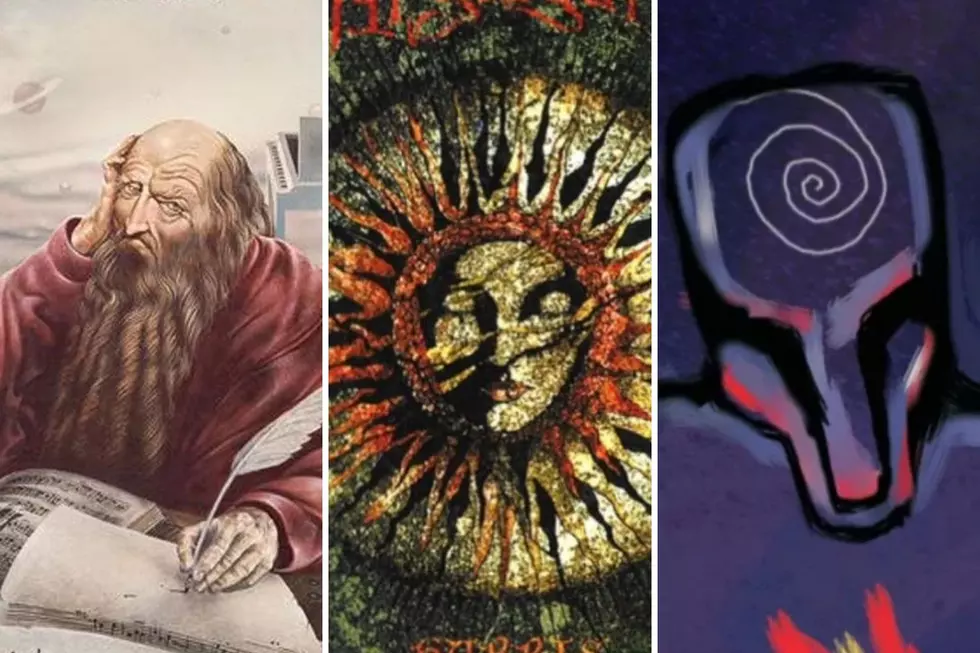
Metal Blade Records / Radiant Records / Chrysalis Records / Inside Out Music 5. Beardfish, "Sleeping in Traffic"
Length: 35:44
The title track (and finale) of Beardfish’s late-2000s double album, “Sleeping in Traffic” shows why the Swedish ensemble are one of few modern prog rock acts that could rival any of their 1970s predecessors. We’re talking irresistible melodies, quirky sound effects, imaginative lyrics and delightfully eccentric arrangements that – like most of their catalog – clearly draw upon older influences while feeling unique to their aesthetic.
According to frontman/multi-instrumentalist Rikard Sjöblom, it was inspired by a “vivid” dream and it centers around “this guy who ends up in a whole lot of crazy situations” within “24 hours of his life.”
The storytelling is relatable yet fantastical and highly detailed (“They see me with tired eyes / Hidden coughs: he's full of lies / Cigarette and black tar stains / Darkness feasts on my remains”). It’s also bookended by inventive modulations of one of Beardfish’s most addictive guitar riffs, and in-between, the group masterfully string together different moods and emotions – anger, whimsy, desperation, etc. – with characteristic elements such as spirited narration and proggy takes on non-prog styles (including sea shanty, disco and early rock ‘n’ roll).
Primarily, “Sleeping in Traffic” signifies Beardfish’s love of offsetting their technical proficiencies with lovable playfulness.
4. Echolyn, “Mei”
Length: 49:28
We’ve long championed Echolyn’s unmistakably sunny sophistication, complex vocal arrangements and mix of sincere and sardonic perspectives. After spending roughly a decade establishing those traits on wonderful collections such as 1992’s Suffocating the Bloom and 1995’s As the World, the gang decided to try their hands at the requisite album-long suite with 2002’s Mei. The result is a highly technical and tender observation of “love, hope, and redemption” – as guitarist/vocalist Brett Kull once explained – that’s sure to put a smile on your face.
Mei begins like an uplifting movie score, with gentle instrumentation (including various rock and orchestral timbres) coating Ray Weston’s pastoral optimism (“Outside it is blue and green / And everything once blurred is clear”). That template reoccurs throughout the remaining dozen or so movements as Echolyn repeatedly shuffle between vibrantly frisky aggression (“All That's Golden,” “Infernal Scratch”) and purifying countryside splendor (“Whispers,” “Hope Renewed”). In the process, they craft more gorgeous melodies and lovably bizarre segues than you can count on two hands.
As you’ll soon see, Mei isn’t the greatest endeavor of its kind, but it’s not far behind, and its ability to entertain as it soothes your soul is immensely special.
3. Transatlantic, “The Whirlwind”
Length: 1:17:46
As the premier American genre supergroup, Transatlantic – who consisted of singer/multi-instrumentalist Neal Morse (ex-Spock’s Beard), drummer Mike Portnoy (Dream Theater), bassist Pete Trewavas (Marillion) and guitarist/vocalist Roine Stolt (The Flower Kings) – routinely delivered on the promise of their combined pedigrees. Thus, almost everything they did was pure prog rock gold, and despite its nearly 78-minute length arguably being a bit extraneous, The Whirlwind is the ultimate amalgamation of their excellence.
Primarily – and with Trewavas and Portnoy’s illustrative techniques on full display – it combines Morse’s penchant for theological drama and keyboard-driven tumultuousness with Stolt’s lighter and more lusciously colorful aesthetic.
Expectedly, the multifaceted “Overture / Whirlwind” is a rambunctious but sobering overview of the devastation to come. From there, the quartet juxtapose theatrical sorrow and fear (“The Wind Blew Them All Away,” “Rose Colored Glasses,” “Is It Really Happening?”) with single-worthy sing-alongs (“A Man Can Feel,” “Set Us Free”) and stunningly flashy jams (“On the Prowl,” “Pieces of Heaven”).
All four men contribute vocals, too, which adds a ton of personality and charm to what’s already a magnificent journey.
2. Phideaux, “Snowtorch”
Length: 36:10
Led by singer/songwriter Phideaux Xavier, Phideaux’s environmental/sociopolitical songwriting and sublimely eccentric folk/symphonic prog rock portraits should make them a household name within the scene. Case in point: the spellbinding two-part “Snowtorch,” which we previously named the best prog rock song of 2011. Admittedly, “Part One” is slightly stronger than "Part Two," but the entire thing is packed with such stately exuberance and strange inventiveness that it’s virtually impossible to turn away once it gets going.
That first half is where the truly exhilarating and heavy “progginess” rests, as it quickly evolves from a softly foreboding prelude into a energetic collage of trance-inducing motifs, male/female duetting and wholly imaginative and unpredictable instrumental breaks. It even gets a bit danceable by the end, and although the second half is relatively abstract, its ingeniously refreshing reprisal of themes and generally lighter tone make it nearly as satisfying but considerably dreamier and more rustic.
Compared to the other entries on this list, “Snowtorch” is criminally obscure, so we implore you to discover it – and the rest of Phideaux’s enchanting catalog – ASAP.
1. “Jethro Tull, “A Passion Play”
Length: 45:07
If you’ve read our prog rock lists before, there’s a good chance you knew this would be our top pick.
Essentially, Jethro Tull’s follow-up to their superb Thick as a Brick is markedly darker and less immediately inviting. But, it’s precisely that daring spirit, the challenge it presents to the listener and the demanding intellectual nature, all of which elevate the 45-minute (four-act) A Passion Play above its predecessor and above every other 30-plus-minute prog rock epic ever made.
Its mysterious tale of a man pondering his principles and humanity in the afterlife is inherently fascinating, and the band tell it with an overwhelmingly hypnotic array of catchy melodies (“Overseer Overture,” “Best Friends,” “The Foot of Our Stairs”) and seductively peculiar classical/prog/jazz passages (“Memory Bank,” “Critique Oblique,” “Magus Perdé”). The two “Forest Dance” segues are enthrallingly grand, too, and naysayers be damned, endearing storybook interlude “The Story of the Hare Who Lost His Spectacles” brings authenticity to the LP’s function as a multiact, well, play.
It’s somewhat understandable why Thick as a Brick is largely preferred over A Passion Play, yet it’s also easy to see that (as the saying goes) the former walked so that the latter could run. Simply put, A Passion Play is an absolute work of genius that never loses its spark.
More From Loudwire